May 26, 2026
Vietnam doesn’t need to beat Meta. It needs to build what Meta never will.

The first thing a child experiences may not be language, love, or education. It is the environment.
Before opening their eyes to the world, every baby has already lived through months of heatwaves, air pollution, floods, changing diets, infectious disease risks, and stress experienced by the mother. We often ask how climate change will affect future generations. What if it already begins before birth?
In Vietnam, where extreme heat, air pollution, salinity intrusion, typhoons and changing rainfall patterns are becoming more common, pregnancy may be one of the earliest and least visible frontiers of climate change.
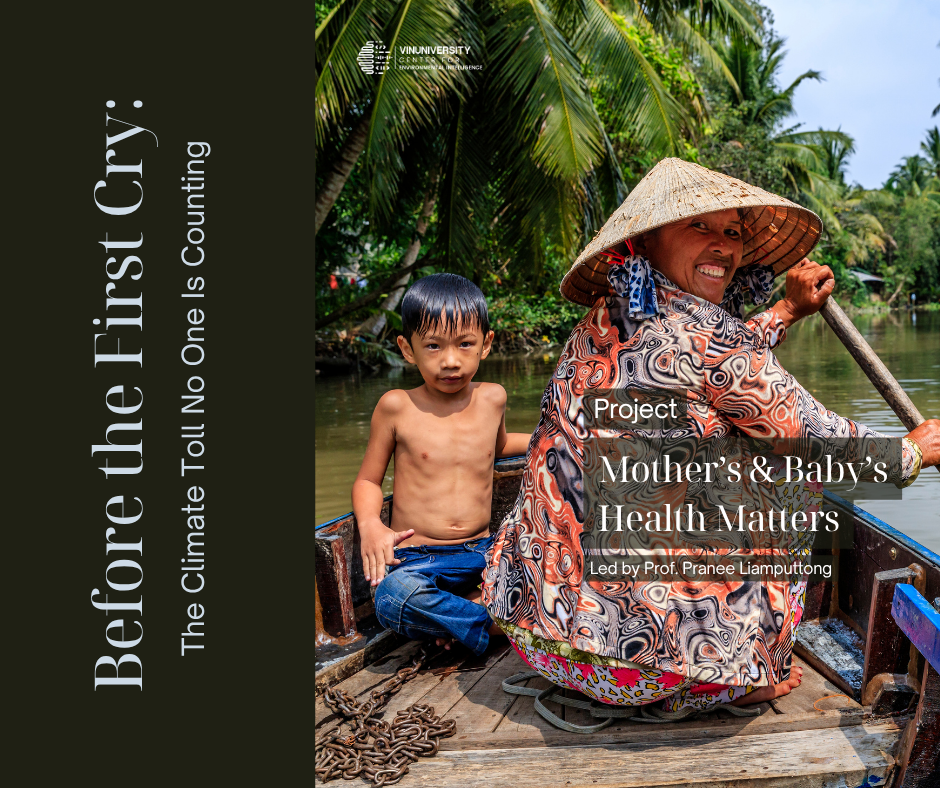 A new qualitative research project from CEI, led by Prof. Pranee Liamputtong, is asking what it actually means to be pregnant on the frontlines of Vietnam’s climate crisis.
The research is grounded in the Mekong Delta, Vietnam’s “food bowl,” and one of the places where climate change has stopped being a forecast and become a daily condition. Saltwater is moving inland into rice paddies. Land is sinking by centimetres a year. Rice yields are projected to fall by up to 15% by 2030, and as much as 30% by 2050. Droughts strain household water supplies; floods disrupt roads and clinics just when a woman may need them most.
None of this reads, at first glance, as a maternal health story. But limited access to safe water, rising heat, disrupted food security, and weakened local health infrastructure land squarely on the bodies of pregnant women and their newborns.
Public health research already has a rough sketch of the danger. Air pollution has been linked to preterm birth, low birthweight, stillbirth, and miscarriage. Heat exposure during pregnancy is associated with complications for both mother and fetus. Extreme weather events raise the risk of postpartum depression and post-traumatic stress. Women are more vulnerable than men to several of these pathways, a pattern researchers trace to biology, but also to who is expected to fetch the water, cook over the fire, and keep working the fields through a heatwave.
But none of this is currently counted as climate statistics. If a pregnant woman in the Mekong Delta falls ill after a heatwave, or loses her pregnancy after a season of drought and salt-poisoned water, no system records climate change as the cause. It disappears into general maternal health statistics, and therefore un-actionable.
So instead of starting from a dataset, the research team is starting from the women themselves. Over the next two years, researchers will live alongside roughly fifty participants across Mekong Delta communities, thirty pregnant women and new mothers, and twenty key informants including husbands, elders, and community leaders. They will sit in homes, walk to rice fields and markets with the women who make that walk every day, and ask them, unhurried, what this most vulnerable moment in their lives actually feels like under a changing sky.
The methods are as deliberate as the questions. Participant observation over six months, so researchers understand daily life rather than sample it. Walking interviews, so conversation happens where the risk lives such as on the path to the field, not across a desk. And photovoice, in which women use their own phones to photograph what climate change looks like in their own lives, images that will later travel into policy rooms far from the delta.
This is not a study designed to surface the practical, often improvised strategies women already use to protect themselves and their babies, and to find out, directly from them, what kind of simple technology or support would actually help.
Climate change usually appears in reports in millimeters of sea-level rise and degrees of warming. In the Mekong Delta, it also appears, quietly and so far measured by no one, in miscarriages and premature births, in the mental toll of raising an infant through a drought, in the quiet calculations a pregnant woman makes about whether it’s safe to walk to the clinic today.
This project exists to make sure that measurement finally gets taken, and that the women living through it are the ones telling us what it means. What researchers learn in the Mekong Delta will not stay there. Similar pressures are converging on pregnant women across low-lying, climate-exposed regions worldwide. A framework built from listening to fifty families in southern Vietnam could shape how maternal health systems anywhere prepare for a hotter, less predictable world.
Before a child’s first cry, climate change has already had its say. This research is an attempt to make sure it isn’t the only one.